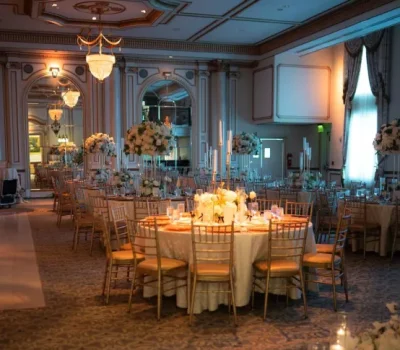
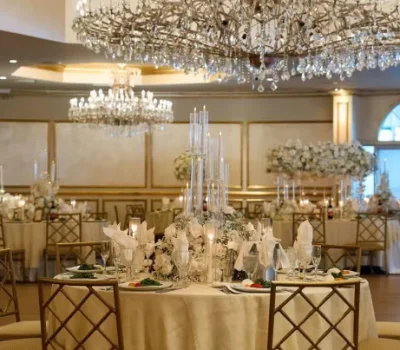
Prospect Heights sits right where Brooklyn gets interesting. The Brooklyn Museum on one edge. The Botanic Garden on another. Grand Army Plaza anchoring the northwest corner with its triumphal arch and its Saturday greenmarket. Barclays Center humming with energy a few blocks south. All of that cultural gravity packed into a compact residential neighborhood where the brownstones are gorgeous, the restaurants punch above their weight, and the couples planning weddings have access to some of the most extraordinary venue options in the entire city. Bloom Wedding Florist Brooklyn has designed wedding florals in Prospect Heights for years – from grand-scale receptions at landmark institutions to forty-person dinners inside neighborhood restaurants where the chef came out to see the table before guests arrived.
No other Brooklyn neighborhood concentrates this much venue firepower into such a small radius. Within a fifteen-minute walk, a couple can choose between a world-class museum, a botanical garden that grows its own ceremony backdrop, a public library rotunda with Beaux-Arts architecture, and a dozen restaurants and event spaces ranging from sleek modern to exposed-brick industrial. That density of options is a gift for couples and a genuine challenge for florists.
The challenge is this: each of those venues carries such strong visual identity that the flowers can’t operate on autopilot. A floral design that sings inside the Brooklyn Museum’s airy galleries would feel lost inside a moody Vanderbilt Avenue wine bar. The same ceremony arrangement that works under the cherry blossoms in the Botanic Garden would look absurd on a museum terrace at night. Prospect Heights demands that the floral designer reset completely from venue to venue, and sometimes from room to room within the same venue. Template-based florists get exposed fast in this neighborhood because the venues won’t let generic work slide by unnoticed.
Designing wedding flowers for a venue surrounded by fifty-two acres of cultivated gardens is a strange creative position to occupy. The Garden itself is already doing what we do – growing beautiful things and arranging them with intention. Showing up with a van full of arrangements and trying to outperform a Cherry Esplanade in April or the Cranford Rose Garden in June is a losing strategy. The smarter move, and the one we’ve learned to execute well, is collaboration with the landscape rather than competition.
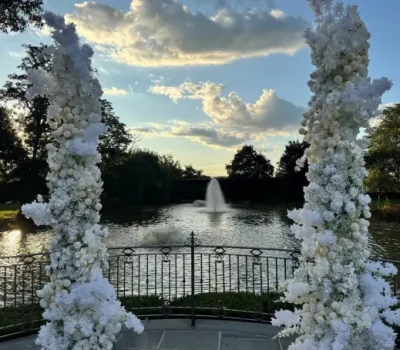
Ceremony florals at the Botanic Garden typically need less volume and more specificity than at an indoor venue. If you’re exchanging vows with a backdrop of wisteria arbors or Japanese maples in full autumn color, a massive floral arch in front of all that is redundant. We might place a single grounded arrangement at the ceremony point and let the Garden do the rest. Or build a minimal ceremony marker – an urn with branches and a few accent blooms – that extends the Garden’s visual language rather than introducing a separate one.
The reception spaces inside the Garden’s event buildings require a different approach. The Palm House has gorgeous iron-and-glass greenhouse architecture with tropical plantings visible through the walls. Arrangements here should echo that botanical context without mimicking it. We’ve used tropical accent blooms – orchids, protea, anthurium – at Palm House receptions that nodded toward the greenhouse environment while standing clearly as designed floral pieces rather than extensions of the permanent collection.
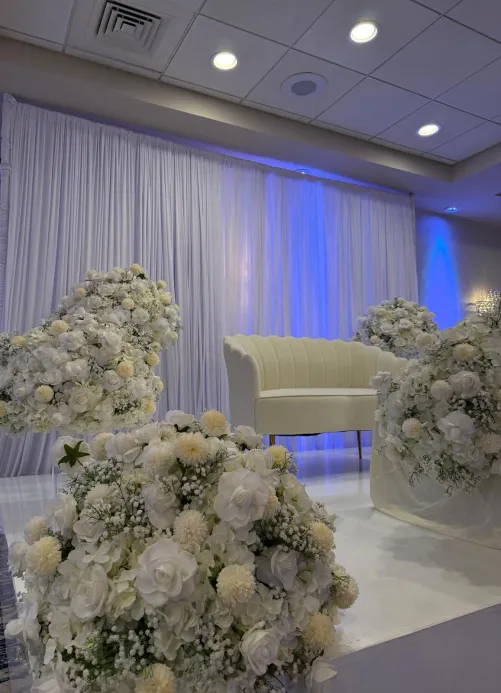
The Atrium is more neutral – a clean event space with less built-in character than the Palm House. Floral design can go bolder here. Full centerpieces, statement installations, garlands that run the length of the head table. The room gives us a canvas without imposing its own aesthetic, which is unusual for a Botanic Garden venue and a welcome change of pace when we want to push the design further.
Getting married at an art museum raises the aesthetic stakes automatically. Guests are literally surrounded by curated objects. The visual literacy of the room is higher than average. And the museum’s own spaces – the Beaux-Arts Court, the rooftop terrace, the Martha A. and Robert S. Rubin Pavilion – are architecturally stunning in ways that demand floral restraint in some areas and bold commitment in others.
The Beaux-Arts Court is all arches, columns, and warm limestone. Classical. Symmetrical. The space itself reads as ceremonial without any additions. Ceremony florals here should feel integrated with the architecture – arrangements that sit within the arched alcoves rather than standing in front of them. Matching the venue’s formality without overdressing it takes a florist who understands proportion and historical aesthetic context. We build for these rooms the way a set designer builds for a period film – everything has to feel like it belongs in the era and the environment.
The rooftop terrace at the museum offers skyline views and open sky. After-dark receptions up there are spectacular. The floral challenge is wind exposure and the visual competition from the panoramic view. Same principle as DUMBO rooftops – keep arrangements anchored, weighted, and designed to complement a backdrop that no florist can outperform.
Grand Army Plaza’s Central Library is a stunning Art Deco building that hosts events in its main hall. Gold-leaf details, dramatic murals, a sweeping curved form that makes the interior feel both grand and intimate. We’ve designed weddings here where the floral palette pulled directly from the warm golds and deep greens in the existing murals – creating arrangements that felt like they’d been commissioned alongside the original artwork. A tight palette discipline works best in this room because the architecture provides so much visual information that a busy floral scheme creates noise rather than beauty.
Not every Prospect Heights wedding happens at a landmark institution. Plenty happen at the neighborhood’s excellent restaurants and intimate event spaces, and these smaller celebrations present their own design opportunities.
Olmsted. A restaurant with a working garden in the back that grows ingredients for the kitchen. Hosting an event here means the floral design needs to respect a farm-to-table philosophy that extends to the physical space. We’ve used herb accents, edible flowers, and locally grown seasonal stems for Olmsted events that aligned the floral approach with the restaurant’s entire ethos. Rosemary from our supplier sitting on the same table as a dish seasoned with rosemary from their garden. That coherence isn’t accidental. It takes coordination between the floral designer and the venue.
Chuko. Japanese-inspired food in a sleek, modern space. Tight quarters, clean lines, minimal existing decor. A few well-placed ikebana-inspired arrangements – structured, asymmetrical, spare – match the restaurant’s aesthetic far better than lush garden-style builds would. We’ve done rehearsal dinners at Chuko with a single branch arrangement on the table that held more visual authority than a dozen roses could have in that context. The space demanded restraint and the restraint paid off in photographs where the food, the flowers, and the environment all spoke the same language.
Vanderbilt Avenue has become a dining corridor that hosts engagement parties, rehearsal dinners, and micro-weddings regularly. Each restaurant along the strip carries a different vibe. We’ve worked several of them and approach each one fresh because a warm candlelit Italian spot and a bright modern brunch place two doors down need entirely different floral thinking.
The brownstones in Prospect Heights are architecturally varied in ways that affect interior floral design. Some are full Victorian with ornate woodwork, heavy pocket doors, and dramatic ceiling medallions. Others have been renovated into clean modern spaces with the original facade preserved but the interior stripped to something minimal and contemporary. The same stoop can lead to two completely different worlds depending on what the homeowner did to the inside.
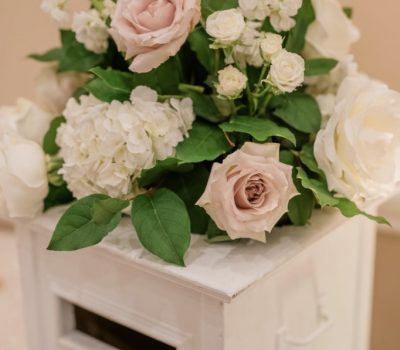
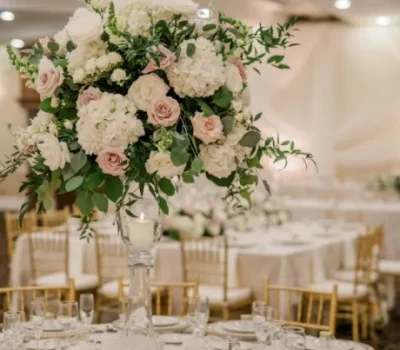
Victorian interiors call for arrangements with a richness that matches the existing ornamentation. Lush, full, slightly romantic – garden roses in warm tones, trailing ivy, maybe a single dramatic bloom like a peony or a dahlia anchoring each piece. The arrangements need visual weight to hold their own against carved mantels and stained glass.
Renovated modern interiors flip the script. Clean vessel lines. Monochromatic or severely limited palettes. Architectural blooms – calla lilies, orchids, birds of paradise – that complement minimalist furniture and white walls. Putting a loose garden-style arrangement inside a space with Scandinavian furniture and polished concrete floors creates a visual argument between two aesthetics, and neither one wins.
We determine which direction to take during the home visit. Not from photos. In person. Because the feel of a room – how the light falls across the floor in the afternoon, how the wall color shifts the perception of a bloom held against it, whether the ceiling height makes a tall arrangement feel proportional or ridiculous – only registers when you’re standing inside it.
Couples booking the Brooklyn Botanic Garden need to understand that the Garden’s own seasonal display will dominate the visual experience whether they plan for it or not. Cherry blossom season in April transforms the grounds into a pink-and-white spectacle. The rose garden peaks in June. The Japanese Hill-and-Pond Garden is most striking in October when the maples turn. These seasonal rhythms are the Garden’s personality, and fighting them with contradictory floral choices is a mistake we help couples avoid.
Spring Garden weddings get floral designs that ride the wave of what’s already blooming outside. If cherry blossoms are everywhere, we bring that softness indoors with blush and white arrangements that extend the experience from the ceremony grounds into the reception space. We don’t use actual cherry blossom branches – cutting from the Garden’s collection would be outrageous – but we source quince, flowering plum, or other spring branches that carry a similar energy.
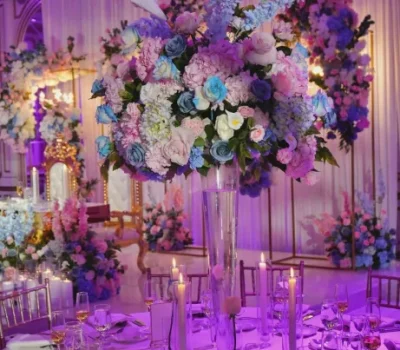
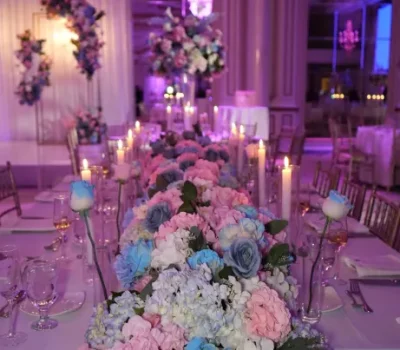
Summer weddings coincide with the Garden’s fullest lushness. Everything is green and overgrown and alive. Our designs push toward the richer end of the color spectrum during summer months – deep corals, saturated pinks, warm yellows – so the flowers inside stand apart from the green wall visible through every window.
Fall is when the Garden becomes a destination for foliage tourists, and a wedding held during peak color benefits from a backdrop no florist could replicate with any budget. We’ve designed October Botanic Garden receptions where the table florals used the same warm amber and red tones visible through the windows, creating a seamless visual flow between the cultivated landscape outside and the designed environment inside. Guests couldn’t tell where the Garden’s work ended and ours began. That was the point.
Winter strips the Garden down to structure – bare branches, evergreen hedges, quiet beauty. Winter weddings here move indoors entirely, and the floral design carries the full atmospheric responsibility without seasonal landscape support. Moody palettes, heavy texture, lots of candlelight integration, and arrangements with branch elements that echo the skeletal beauty of the winter garden outside. These are some of the most design-forward weddings we produce because there’s no lush backdrop to lean on. The flowers stand alone.
Here’s a detail nobody else mentions. The Grand Army Plaza greenmarket on Saturday mornings sits a five-minute walk from most Prospect Heights venues. We’ve sourced accent elements from the greenmarket for Prospect Heights weddings when timing cooperated – locally grown dahlias from an upstate farm, herb bundles for table accents, heirloom apples for fall tablescapes. These hyper-local sourcing moments add a layer of authenticity that couples in this neighborhood particularly appreciate. A dahlia that grew eighty miles away and was picked yesterday morning carries a different energy than one flown in from Colombia, and Prospect Heights couples tend to feel that distinction intuitively.
We don’t rely on the greenmarket as a primary source – our wholesale supply chain through the Chelsea Flower Market is too reliable and varied to replace. But supplementing with greenmarket finds when the quality is exceptional adds a local dimension that enhances both the freshness and the story behind the arrangements.
The neighborhood’s main arteries – Flatbush, Atlantic, Vanderbilt – are high-traffic corridors at virtually all hours. Residential side streets offer better access and calmer load-in environments for brownstone events. Museum and Botanic Garden deliveries follow institutional loading dock protocols that vary by venue – the museum has a dedicated service entrance on the east side of the building, while the Botanic Garden requires advance vehicle registration for access through the service gate.
We schedule Prospect Heights deliveries based on which venue we’re working. Institutional venues get early morning calls coordinated with their event teams weeks in advance. Restaurant setups happen during the window between lunch service and event time – usually 2 to 4 PM – when the staff is resetting the space and can accommodate our presence. Brownstone weddings get the standard residential protocol: arrive early, park on the side street, hand-carry through the front door, assemble inside.
Prospect Heights is close to our Herkimer Street studio. The drive takes fifteen minutes without traffic, which means our delivery window is flexible and our crew can make multiple trips if a complex installation requires staged load-in. That proximity is a genuine operational advantage for Prospect Heights weddings – we can prep a piece in the studio, deliver it, return for the next batch, and repeat without the hour-long round trips that Bay Ridge or far-flung Brooklyn venues require.
Institutional venues in Prospect Heights come with premium rental fees. Couples booking the Botanic Garden, the Museum, or the Library are already making a significant financial commitment before flowers enter the conversation. Sometimes that leaves a comfortable floral budget. Sometimes the venue rental consumed the bulk of the wedding fund and the flowers need to work harder per dollar.
We’ve designed beautiful Botanic Garden weddings at both ends of that spectrum. High-budget receptions with suspended installations over the dance floor and garlands running every table. Moderate-budget celebrations where we concentrated the floral investment on personal flowers and a single ceremony focal point, letting the Garden’s own beauty handle the rest. Both approaches resulted in gorgeous events because the strategy matched the budget rather than pretending the budget didn’t exist.
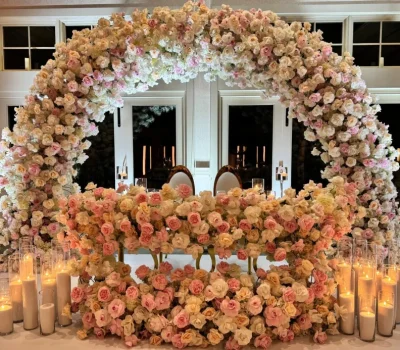
The honest conversation about money happens early with Prospect Heights couples. We ask what the venue rental cost because it tells us approximately how much flexibility remains for florals. If a couple spent $25,000 on the venue and has $3,000 left for flowers, we’re not going to pretend that buys a full-scale floral production. We’ll design the most impactful $3,000 of flowers they’ve ever seen and position every piece where it earns maximum value. That might mean skipping guest table centerpieces entirely and putting the entire budget into a ceremony backdrop, personal flowers, and a sweetheart table build. Unusual allocation? Sure. Better than spreading $3,000 across fifteen tables and having nothing in the room make an impression? Every time.
Not just the room. The Garden. The museum gallery. The landmark library. The renovated brownstone. The chef-driven restaurant. Each of these spaces speaks a visual language, and the flowers either speak it fluently or stumble through with an accent that everyone notices but nobody can quite name.
Bloom Wedding Florist Brooklyn has spent years becoming fluent in Prospect Heights’ venues, seasons, and couples. We know when the cherry blossoms peak. We know which museum galleries have restrictions on freestanding installations. We know which brownstone parlors have mantels deep enough for an arrangement and which ones are decorative only. We know where the greenmarket dahlia vendor sets up on Saturday mornings.
Call (929) 673-2834 or visit 111 Herkimer St, Brooklyn, NY 11216. Whether your Prospect Heights wedding lives inside a cultural institution or a living room, the flowers need a designer who understands the room well enough to know exactly when to fill it and when to get out of its way.