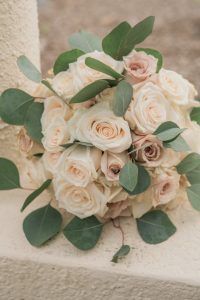
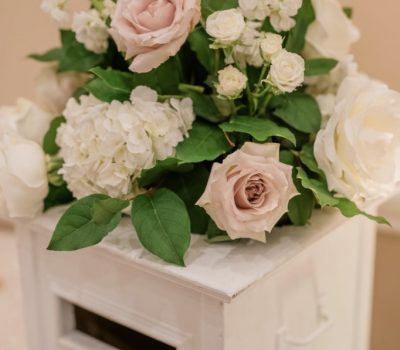
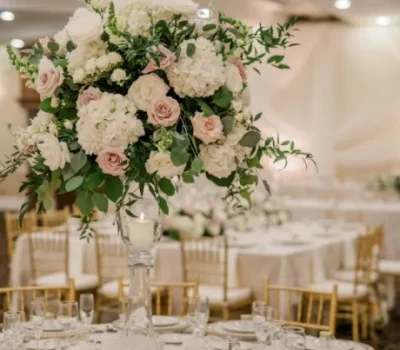
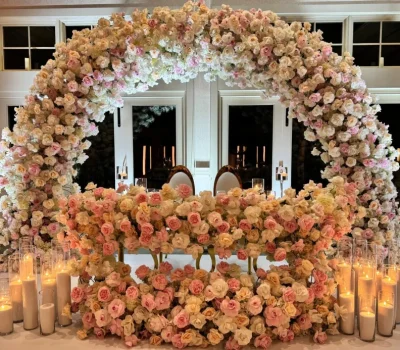
They’re the smallest floral pieces at any wedding and somehow the ones people get the most sentimental about. A boutonniere pinned to a groom’s lapel during a quiet moment in the getting-ready suite. A wrist corsage slipped onto a grandmother’s arm right before she walks to her seat. These aren’t centerpieces that sit twenty feet away from the nearest camera. They’re worn on bodies, pressed against suit jackets during bear hugs, visible in every close-up portrait taken throughout the day. At Bloom Wedding Florist Brooklyn, we give these tiny builds the same focused attention we give a ceremony arch – because in the photos that matter most, the personal flowers are the ones that show.
Ask any mother of the bride what she remembers about the morning of the wedding and she’ll probably mention the moment someone pinned her corsage on. It’s a ritual. A quiet acknowledgment that says “you matter to this day.” Same with the groom’s boutonniere. His best man helps pin it. Someone takes a photo. It’s one of those small, still moments before everything accelerates.
We’ve watched these moments happen hundreds of times and the detail that always strikes us is how closely people look at the bloom. Not from across the room. From three inches away. They tilt it. Study it. Smell it. Comment on the specific flower. That proximity means construction flaws are fully exposed. A wilting petal at that distance ruins the impression. A visible wire looks amateur. Tape that wasn’t wrapped cleanly enough catches light in photos and screams “DIY gone sideways.” These pieces are tiny, but the margin for error is actually smaller than on a large arrangement because there’s nowhere for a mistake to hide.
People assume you just cut a flower, wrap the stem, and pin it on. If that’s the process, the flower dies in ninety minutes and droops sideways by the ceremony. Our construction method takes about fifteen minutes per piece – roughly twelve times longer than the snip-and-pin approach – and the difference holds up across an entire wedding day.
It starts with wiring. We insert a thin gauge floral wire through or alongside the stem, giving the bloom structural support it can’t provide on its own. A ranunculus bud wired correctly will hold its position on a lapel for eight hours straight. Without wiring, it nods forward within the first hour as the natural stem softens. After wiring, the stem gets taped with floral tape in a tight spiral from the base of the bloom down to the trimmed end. This creates a clean, uniform stem that won’t snag fabric or poke through a jacket lining.
Next comes the accent work. A sprig of eucalyptus, a tiny fern frond, a few seeds of brunia or a single hypericum berry tucked alongside the main bloom. These supporting elements add dimension and visual interest to a piece that’s barely three inches across. Getting the proportion right is genuinely tricky. One accent too many and it looks cluttered. Too few and it reads as unfinished. The eye needs just enough complexity to stay interested without feeling overwhelmed at that scale.
Final step is a moisture wrap at the base – a tiny cotton ball soaked in water, sealed in waterproof tape, that keeps the stem hydrated throughout the day. Invisible to anyone looking at the finished piece. Critical for keeping the bloom alive from the 10 AM pinning through the midnight send-off.
A boutonniere should feel like it belongs at your specific wedding, not like a generic floral pin that could show up anywhere. The style shifts dramatically depending on the overall aesthetic, and we design accordingly.
Classic and formal. A single white rose or ivory ranunculus with a small leaf accent and clean ribbon wrap. Tight, polished, symmetrical. Sits flat against a tuxedo lapel without disrupting the clean lines of the suit. This is the boutonniere for a black-tie reception at a Brooklyn Heights venue or a candlelit ceremony at a Dumbo waterfront space.
Garden and romantic. A more organic build – maybe a spray rose slightly open, a wisp of jasmine vine, a bit of dusty miller for that silvery texture. Looser stem wrap, longer visible stem, a slight intentional asymmetry. Pairs well with lighter-colored suits, linen, and outdoor ceremonies in Prospect Park or Red Hook garden venues.
Modern and minimal. A single architectural bloom – a small orchid, a tight protea bud, a succulent rosette – with zero accent greenery. Just the bloom and a clean wrap. Sharp, unexpected, and strong against dark suits and clean-lined venues in Williamsburg or Greenpoint.
Rustic and textural. Dried elements mixed with fresh – a small thistle, a dried craspedia ball, a fresh herb sprig like rosemary or lavender, maybe a snippet of wheat or dried grass. These builds have a wild, collected-from-a-field quality that works beautifully at barn-style or farm-table Brooklyn weddings.
The groom’s boutonniere always stands apart from the rest of the group. It echoes the bridal bouquet directly – featuring the same anchor bloom in miniature or a distinct variety that appears nowhere else in the groomsmen’s pieces. If the bride carries garden roses, the groom wears a single garden rose bud while his groomsmen wear spray roses or ranunculus. That subtle distinction signals his role without being obvious about it. Most guests won’t consciously register the difference. The photographer will. And in portraits of the couple, the visual connection between her bouquet and his lapel creates a quiet harmony that ties the frame together.
Groomsmen boutonnieres run a step simpler than the groom’s. Same palette, same general botanical family, slightly reduced scale or a different bloom variety. We build these to read as a set without looking mass-produced. Maybe each groomsman gets a slightly different accent green. Maybe the bloom stage varies – one bud slightly more open than the next. Small moves that keep the lineup interesting in photos where six identical suits stand side by side.
The word “corsage” makes a lot of people picture a high school dance. Big floppy orchid on a white elastic band, already browning by the second slow song. That’s not what we build. Modern wrist corsages are jewelry-adjacent – delicate blooms mounted on bracelets, cuffs, and bangles that the wearer keeps long after the flowers themselves are gone.
We work with several base options. Pearl stretch bracelets for a classic feel. Thin gold or silver cuff bangles for something modern. Silk-wrapped wire bands that feel barely there on the wrist. Vintage-style beaded bands for weddings with an heirloom quality. The hardware matters because the corsage sits at the intersection of fashion and flowers – it needs to complement a dress, coordinate with jewelry, and feel comfortable on a wrist for hours without pinching, sliding, or weighing the arm down.
The blooms mounted to these bases stay small and light. A single spray rose. Two or three wax flower buds. A miniature orchid bloom. A tiny cluster of ranunculus or garden rose petals wired into a rosette shape. Accent greenery stays minimal – a single leaf, a tiny eucalyptus sprig – so the piece reads as refined rather than overgrown. We attach everything with waterproof floral adhesive and wire, then tape any visible mechanics so the underside looks as clean as the top.
Not everyone wants something on their wrist. Some mothers and grandmothers prefer a pin-on corsage at the shoulder, collar, or handbag. We build pin-on versions using the same attention to bloom selection and accent work, mounted on a magnetic or traditional pin back depending on the garment.
Magnets work best on structured fabrics – blazers, suit jackets, thick wool. They grip through the material without puncturing it, leaving no holes in an expensive outfit. Traditional pins are better for softer fabrics and lighter placements where a magnet might slide. We ask what each recipient will be wearing before deciding which attachment method to use. Sounds like a small thing. Matters enormously when a grandmother’s silk dress gets a pin hole in it because nobody asked about the fabric.
The list expands quickly. Groom. Best man. Groomsmen. Father of the bride. Father of the groom. Stepfathers if applicable. Grandfathers. Ring bearer. Officiant, sometimes. Ushers, sometimes. Mother of the bride. Mother of the groom. Stepmothers. Grandmothers. Readers or performers, occasionally. That’s easily fifteen to twenty individual pieces at a mid-sized wedding, and each one needs to be built, labeled, boxed, and delivered to the right person at the right time.
We create a master list during the planning phase. Name. Role. Piece type – boutonniere or corsage. Attachment method – pin, magnet, wrist. Any special considerations – allergies, fabric type, color of outfit, personal bloom preference. A grandmother who adores violets gets violets in her corsage even if they appear nowhere else in the wedding design. A father who hates anything on his lapel gets a discreet pocket square bloom instead. These personal details are the whole point of custom floral work. We ask the questions that most florists skip.
Every corsage and boutonniere leaves our studio in an individual labeled box with the recipient’s name and role written clearly on top. Corsage boxes include a photo card showing how to wear the piece – wrist position, clasp direction, which way is up. Boutonniere boxes include a small pin kit with backup pins in case one bends during application.
We deliver these boxes to the getting-ready locations the morning of the wedding – one set to the bridal suite, one set to wherever the groom’s party is dressing. When the timeline allows, a member of our team personally pins every boutonniere. Correct placement sits on the left lapel, stem pointing downward, pin hidden behind the stem wrap at a slight upward angle so the weight of the bloom doesn’t pull it forward. That three-minute pinning job determines whether the boutonniere stays put through hugs, dancing, and jacket removal at 11 PM or whether it migrates sideways by the first dance.
If our team can’t be present for pinning – overlapping events, tight morning schedules – we include a printed instruction card with diagrams. Clear enough that a best man who’s never touched a flower in his life can pin a bout correctly on the first try.
Boutonnieres and corsages make surprisingly good preservation candidates. Their compact size means they press flat beautifully, dry evenly, and fit into resin molds and shadow boxes without much manipulation. We’ve had couples frame the groom’s boutonniere alongside a pressed bloom from the bridal bouquet. One bride preserved her grandmother’s corsage in a small resin block that now sits on a bookshelf.
If preservation interests you, let us know during the design phase. We’ll select varieties that hold their color and structure through drying or pressing – avoiding blooms that brown, crumble, or lose petal integrity when they dehydrate. A ten-second conversation during planning gives you a keepsake that lasts decades.
Wide reception photos show off your centerpieces. Ceremony shots feature your arch. But the photos you’ll look at most – the ones framed on nightstands, shared in anniversary posts, pulled up on phones to show friends – those are the close-ups. The first look. The vow exchange. The parent dances. The toasts. And in every one of those images, the personal flowers are right there. Pinned to a chest. Clasped around a wrist. Visible in a frame tight enough to count individual petals.
Those flowers deserve a florist who treats them with the precision their proximity to the camera demands. Bloom Wedding Florist Brooklyn builds every corsage and boutonniere as if it’s going to be photographed from three inches away – because it will be. Call (929) 673-2834 or come to 111 Herkimer St, Brooklyn, NY 11216. Let’s make sure every personal bloom at your wedding holds up to the close-up.