Centerpieces do something no other floral element at a wedding can – they sit inches away from your guests for hours. People lean around them to talk, photograph their plates next to them, touch petals absent-mindedly between courses. At Bloom Wedding Florist Brooklyn, we’ve designed centerpieces for tables of four and tables of forty, and the approach changes every single time because no two receptions eat, drink, or celebrate the same way.
Forget decoration for a second. A centerpiece is functional architecture. It defines whether two people sitting across from each other can make eye contact. It determines how candlelight behaves on a tabletop. It affects where a server sets down a bread basket, where the DJ points a spotlight, and how a photographer frames a wide shot of the reception floor during toasts.
We’ve watched enough receptions to know exactly when a centerpiece fails. Too tall and guests crane around it all night. Too low and it vanishes into the tablescape. Wrong color temperature under the venue’s lighting and the whole palette shifts muddy. These aren’t hypothetical problems. They’re things we’ve corrected in real time at Brooklyn venues over the years – and the reason we now plan for them months in advance.
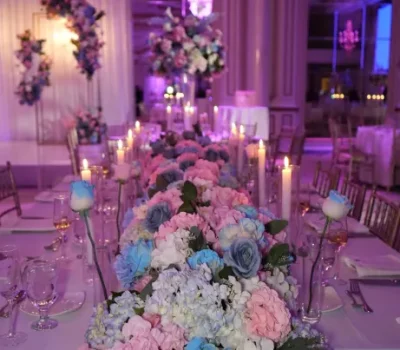
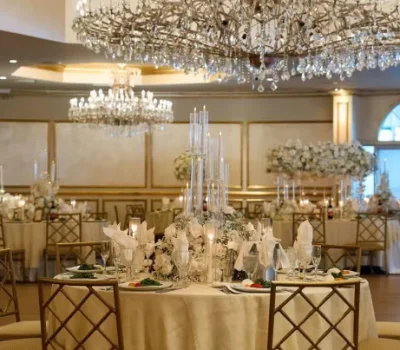
For long communal tables and intimate guest counts, low arrangements tend to work hardest. They let people see each other. They create a sense of abundance running down the table without building walls between guests. But “low” doesn’t mean boring, and it definitely doesn’t mean a glass cube with six roses shoved inside.
Our low centerpieces typically sit in compote vessels, ceramic bowls, or vintage brass containers – depending on the aesthetic. We build them dense and textural, mixing bloom varieties at different stages of openness so there’s visual depth. A peony in full bloom next to a tight ranunculus bud next to a spray of jasmine vine creates movement that a uniform arrangement simply cannot. The best low centerpieces look like a Dutch still-life painting crashed into a Brooklyn dinner party, and we mean that as the highest compliment.
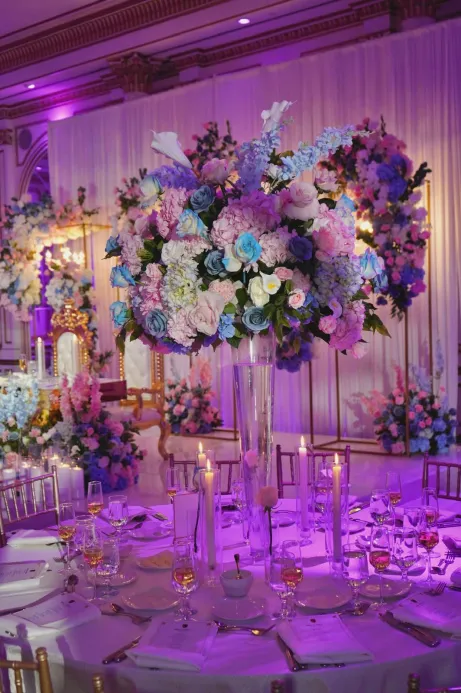
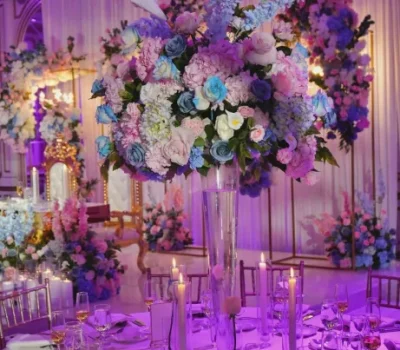
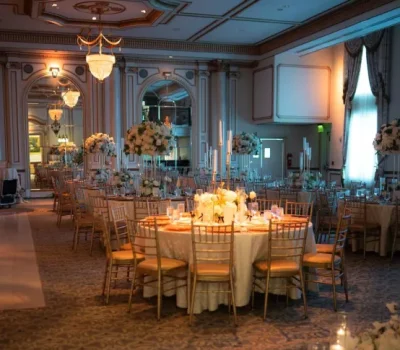
Ballroom. High ceilings. Lots of round tables. That’s when height earns its place. A well-built tall centerpiece fills vertical space that would otherwise feel empty and cavernous — especially in venues like the Brooklyn Museum or large event halls in Bay Ridge where the architecture dwarfs everything at table level.
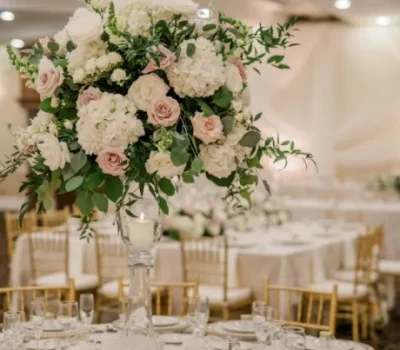
We construct tall pieces on sturdy risers or clear glass trumpet vases, keeping the bulk of the arrangement above eye line so guests aren’t ducking around foliage to find their dinner companion. The base gets a small accent — a wreath of greenery, a few scattered votives — so the table itself doesn’t feel bare. Engineering matters here more than anywhere else in floral design. A top-heavy arrangement on a narrow base near a dance floor full of people is a liability, not a design choice. Our builds get weighted, secured, and tested before a single one leaves the studio.
We maintain a lending inventory of over 200 vessels – gold compotes, mercury glass, matte ceramic, clear cylinder, antique brass. If your venue or planner has rentals, we design into those. If not, ours are included at no extra charge depending on your package.
Before we finalize any centerpiece palette, we ask about your lighting plan. Uplighting? Candles only? Edison string lights? Pin spots on the tables? Each one changes how a bloom reads at 8 PM versus noon, and we adjust the color story accordingly.
A raw industrial loft in Bushwick and a gilded ballroom in Brooklyn Heights ask for completely different floral approaches. Sounds obvious – but you’d be surprised how many florists recycle the same centerpiece formula regardless of the space it’s going into. We don’t operate that way.
When you book with Bloom Wedding Florist Brooklyn, your designer schedules a venue walkthrough whenever possible. We study the table layout, the ceiling height, the wall color, the natural light at your ceremony time versus your reception time. One of our Williamsburg weddings last spring sat under a canopy of existing string lights at Maison May — so we designed intentionally shorter, candlelit centerpieces that let the overhead glow do most of the atmospheric work. Pulled back where the venue was already doing the heavy lifting. That kind of restraint only comes from having spent real time inside these spaces and understanding their rhythms.
Some of the most compelling reception floors we’ve designed used three different centerpiece heights across the room. High arrangements on every third table. Medium compote builds in between. Low clusters with heavy candle groupings scattered throughout. The result, when viewed from the doorway, reads like a landscape – peaks and valleys across the room that draw the eye forward and keep things from feeling monotonous.
This approach does require coordination. Table assignments, escort card layout, guest sightlines to the dance floor or the head table – all of it factors into which height goes where. We map it out on the floor plan with your planner well before the wedding week. No guesswork on install day. By the time our team arrives at the venue, every arrangement has a table number written on it and a designated position on the layout.
A February wedding centerpiece and a September wedding centerpiece shouldn’t look anything alike. Not just because of color trends – because the actual flowers available are fundamentally different, and forcing off-season stems into your design inflates costs and reduces quality.
Winter gives us anemones, amaryllis, hellebores, paperwhites – moody and architectural, perfect for candlelit receptions. Spring opens the door to tulips, hyacinth, sweet peas, and ranunculus in soft pastels that feel fresh without trying. Summer brings the abundance – dahlias, zinnias, lisianthus, sunflowers – punchy, saturated, almost impossible to overdo. Fall hands us garden roses in caramel and rust tones, chocolate cosmos, marigolds, dried grasses, and that warm amber palette that photographs like a dream under golden hour light.
We guide every couple toward what’s thriving during their wedding month. Not what looked good on someone else’s blog from a different coast and a different year.
A centerpiece isn’t always just flowers. Some of our most talked-about designs incorporated elements that had nothing to do with blooms at all. Scattered figs and persimmons on a fall harvest table at The Green Building. Antique books stacked between bud vases at a literary-themed wedding in Fort Greene. Taper candles in mismatched brass holders weaving between low greenery at a Park Slope backyard reception.
These non-floral elements add personality and break the predictability of a room full of identical arrangements. They also help stretch a floral budget further – a table that’s fifty percent candle and fruit and fifty percent flowers can look richer than one that’s a hundred percent blooms if the proportions are right. We talk through all of these possibilities during the design phase so nothing feels like an afterthought or a cost-cutting measure. It just feels like your table.
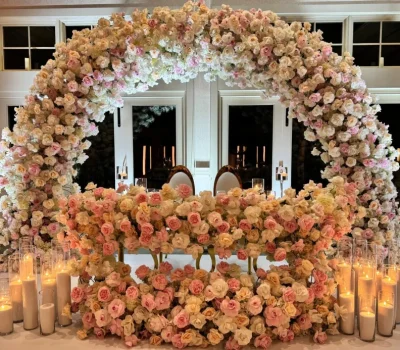
Whatever sits at the front of the room gets the most attention. Period. If you’re doing a long head table with your full bridal party, we typically run a garland or a dense low arrangement the entire length — abundant, cohesive, and low enough for conversation across the table. Sweetheart tables for just the couple get a different treatment. More height allowed since you’re not blocking sightlines between guests. Flanking arrangements on either side. Maybe a small ground installation at the base of the table for depth. This is the one table where we can go a little overboard because it only seats two people and it’s the backdrop for half your reception photos.
We coordinate this focal table with your cake table, gift table, and any escort card display so the entire front-of-room zone tells one visual story instead of three competing ones.
Here’s exactly how it works. You come to our Herkimer Street studio or hop on a video call. We look at your inspiration together – photos, color references, fabric swatches, venue shots. Then we sketch three to four centerpiece concepts at different price points. Not vague descriptions. Actual visual direction with bloom varieties listed, vessel options shown, and rough dimensions noted.
You pick a direction. We refine it. A sample gets built for your tasting or your next planner meeting if timing allows. Final confirmation locks in your flower order with our suppliers four weeks out. Day-of, our crew arrives at the venue hours early, sets every arrangement, styles the non-floral elements, adjusts anything that looks off under the actual lighting, and walks away only when the room is finished. You walk in, see your reception for the first time, and that sharp intake of breath tells us everything we need to know.
When we say “centerpiece design,” we’re really talking about the entire table experience. The arrangement in the middle is the anchor, but the votives, the napkin fold, the color of the linen underneath, the place card holder – all of it either supports or undermines what the flowers are doing. We collaborate with your planner and rental company to make sure every layer works together.
Most wedding florists hand off an arrangement and walk away. We stick around and style the full table because a gorgeous centerpiece sitting on the wrong linen with poorly placed candles is a missed opportunity. And we don’t miss those.
Nobody remembers a forgettable centerpiece, but everybody remembers a great one. The table where the conversation flowed easier. Where the light hit the dahlias and someone pulled out a phone to take a photo before the first course arrived. That’s the reaction we’re building toward every single time. Call Bloom Wedding Florist Brooklyn at (929) 673-2834 or visit our studio at 111 Herkimer St, Brooklyn, NY 11216. Let’s make your reception tables the ones people remember.