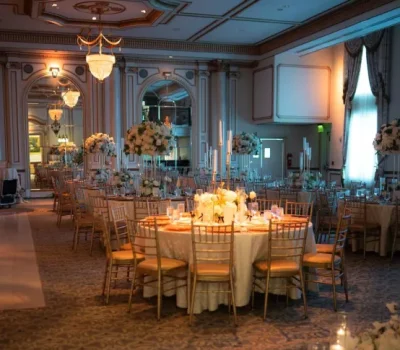
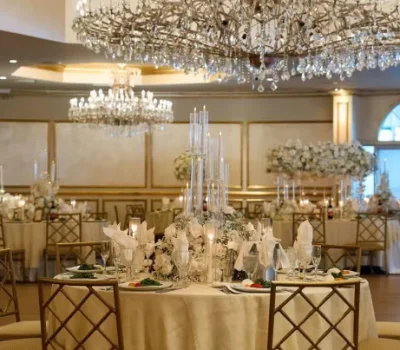
Long tables change a wedding. Round tables keep conversations contained to groups of eight or ten, but a long farm table stretching twenty feet with a garland spilling down the center turns strangers into neighbors. That’s the power of the format – and the garland is what makes it work visually. Without it, you’ve got a bare plank with plates on it. With a good one, you’ve got a feast. Bloom Wedding Florist Brooklyn has been building table garlands and runners for weddings at venues across the borough since we first opened our studio on Herkimer Street, and honestly, these pieces remain some of the most satisfying work we do.
Plenty of florists toss some ruscus on a table, scatter a few votive candles around it, and call it a runner. We see this constantly at venues where we’re setting up and another vendor’s work is already on adjacent tables. Flat. Limp. Gaps where the table shows through. It looks like someone went to the wholesale market, bought five bunches of Italian ruscus, and plopped them end to end.
Building a garland that actually looks abundant requires layering, and layering takes time. You start with a base green – something sturdy with good coverage, like seeded eucalyptus or silver dollar eucalyptus. Then you add a secondary green with a different leaf shape for contrast. Bay laurel against eucalyptus. Nagi against ruscus. Fern fronds mixed with olive branch. That second layer is where depth starts to emerge. Third pass is accent greenery – smaller, more textural pieces like jasmine vine, smilax, or myrtle that weave through the base and create visual movement instead of a monolithic wall of green.
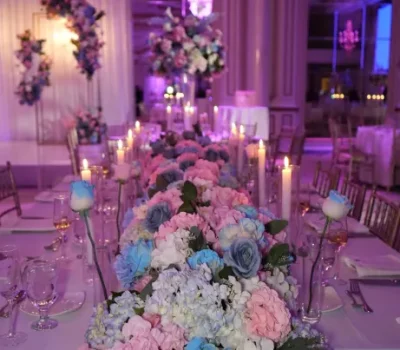
Only after the greenery structure is right do blooms go in. Tucked at irregular intervals. Not evenly spaced every six inches like a pattern repeat on fabric. A cluster of three garden roses at one bend, then nothing for a foot, then a single ranunculus peeking through the eucalyptus, then a burst of spray roses near a candle cluster. Randomness that’s actually choreographed. That’s what makes a garland feel gathered and alive instead of manufactured.
Depends entirely on your table. Most farm tables at Brooklyn wedding venues run six or eight feet. Some venues push two together for twelve. We’ve built single continuous garlands for 24-foot head tables at venues in Williamsburg and 30-foot community tables at a warehouse reception in Red Hook. Each one is custom-measured.
We don’t build garlands in our studio and transport them intact. Can’t. A twelve-foot garland doesn’t fit through a door, let alone into a delivery van without half the blooms getting crushed. Instead, we pre-build sections in the studio – usually in three- or four-foot lengths that are individually hydrated and boxed. On-site, the crew links the sections together on the table itself, filling the connection points with extra greenery so the seams vanish completely. This modular approach is the only way to build at scale while keeping the final product looking like one continuous, uninterrupted piece.
For shorter tables – a sweetheart table, a cake table, a cocktail station – we sometimes build the garland as a single intact piece in the studio and transport it in a long shallow box with wet paper towels at the base. Those shorter builds arrive ready to place. No on-site assembly required. Drop it, adjust it, done in under a minute.
Both work. The choice usually comes down to budget, aesthetic, and what the rest of the floral design is doing.
Greenery-only runners cost less because the materials are less expensive per stem and the build is faster. They also look incredible in the right context. A dense eucalyptus runner with scattered taper candles down a raw wood table at a rustic Bushwick venue? That’s a complete look. Nothing missing. Adding flowers might actually clutter it.
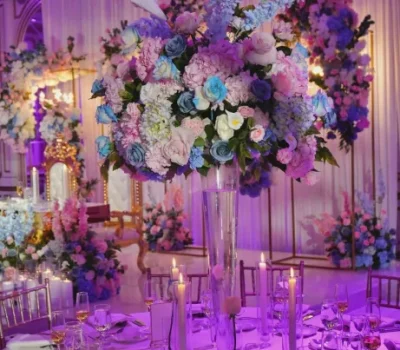
But if your centerpieces are minimal – maybe just a few bud vases on each table – the garland becomes the primary floral moment at the table and blooms earn their place. They add color. They catch light differently than foliage. They give the photographer those tight detail shots where a dinner plate sits next to a rose and the whole frame looks like a magazine spread. We talk through this balance with every couple. Sometimes we mock up a two-foot section of both options during the consultation and lay them side by side on our studio table. Seeing the difference in person settles the debate faster than any conversation could.
Taper candles in brass holders rising out of a garland. Tea lights in glass votives nestled into the greenery. Pillar candles on small mirrored bases at each end. Candles and garlands are natural partners, but placement matters. A taper flame too close to a trailing vine is a fire hazard. A votive buried too deep in dense greenery gets hidden entirely and does nothing. We space candle elements during install with specific clearances and always confirm with the venue whether open flame is permitted. Some Brooklyn venues require flameless candles only. We carry both.
Some of the most striking runners we’ve built weren’t purely botanical. Figs split in half, scattered down a fall table with their pink centers facing up. Pomegranate halves nestled into garland bends during a December wedding. Whole lemons and kumquats tucked between greenery for a Mediterranean-themed dinner in Carroll Gardens. Fresh rosemary and thyme sprigs adding scent alongside the standard foliage at a garden party in Park Slope. These elements cost almost nothing and add a dimension of texture and color that pure greenery can’t achieve on its own.
Farm tables. Round tables. Rectangle banquet tables. Serpentine tables. Each one asks for a different garland format.
Farm tables are the garland’s natural habitat. Long, narrow, usually bare wood. The runner sits directly on the surface and spans the center third of the table width, leaving enough room on each side for place settings, bread plates, and wine glasses. Easy. Comfortable. The design everyone pictures when they hear “table garland.”
Round tables are trickier. A full circular garland wrapping the entire circumference of a centerpiece looks gorgeous but requires more material than a straight run and a different construction method – shorter curved sections rather than long straight ones. Some couples opt for a partial crescent instead. A half-moon of greenery curving around one side of the centerpiece, leaving the other side open. Less material, still impactful, and actually better for guest access to the table from multiple sides.
Banquet rectangle tables at traditional venues sometimes come with tablecloths, which changes the foundation. A garland on bare wood grips naturally and stays put. A garland on polyester tablecloth slides. We pin discreetly through the cloth into foam pads underneath to keep everything anchored, especially if servers will be moving around the table during dinner. Nobody wants a garland in their soup because a waiter’s elbow caught a trailing vine.
Whatever you’re doing on the guest tables, double it at the head table. More density. More bloom frequency. More length – we overhang the ends by six to twelve inches so the garland drapes slightly over the table edges. This creates a lush, overflowing look that photographs beautifully from the guest perspective and signals that this table is the center of attention.
Front-facing garlands are another option for head tables visible from one side only. We build these to cascade slightly over the front edge of the table, creating a visual skirt of greenery and flowers facing the guests. The back side – where the bridal party actually sits – stays flat so it doesn’t interfere with laps, napkins, or champagne glasses. This front-loaded approach concentrates the visual impact where cameras point and keeps the functional side of the table practical.
One head table we built for a Prospect Heights wedding ran eighteen feet with a front-facing cascade that included garden roses, trailing amaranthus, olive branches, and seeded eucalyptus. The garland took four hours to construct on-site and the couple’s planner told us afterward that three separate guests asked who did the flowers based solely on that single piece. It anchored the entire room.
Garlands and runners price per linear foot. The cost per foot depends on three variables: greenery variety, bloom density, and width.
A simple seeded eucalyptus runner with no blooms sits at the low end. Still beautiful. Still professional. Just less material and less labor. Add a second greenery variety and occasional bloom clusters and you’re in the middle range. Go dense – multiple greens, heavy bloom frequency, trailing elements hanging off the table edge – and you’re at the premium end.
We quote garlands as a line item separate from centerpieces so couples can see exactly what each element costs. This matters because garlands have a way of eating a floral budget fast. Twenty feet of heavy garland costs more than most people expect. We’d rather have that sticker shock happen during the proposal review than on the invoice. If the number is high, we talk about where to trim – maybe full garlands on the head table and sweetheart table but greenery-only runners on guest tables. Or garlands on half the tables and bud vase trios on the other half to create variety while managing cost. There’s always a way to get the look without nuking the budget.
Fresh garlands drink water. Cut stems need moisture or they wilt, and a wilted garland at 10 PM is a sad thing to look at when it was gorgeous at 6. We manage this with wet floral foam hidden underneath the greenery base. Strips of soaked foam wrapped in plastic sheeting sit along the table under the garland, providing a moisture reservoir that keeps stems hydrated throughout the evening.
For extremely long receptions – six hours or more – we build an extra hydration cushion into the design by choosing hardier varieties. Eucalyptus lasts longer than delicate fern. Bay laurel outlasts myrtle. Roses tucked into a garland hold up better than hydrangea in the same position. These are boring practical decisions that nobody notices unless we get them wrong – and then everyone notices because the garland looks tired during the last hour when people are still taking photos.
Certain venues run warm. Heated indoor spaces in winter, un-air-conditioned lofts in summer, proximity to kitchen heat sources. We factor ambient temperature into our variety selection. A room running 80 degrees in July gets the most heat-tolerant stems we can source. A cool October evening outdoors gives us more flexibility to use delicate blooms that wouldn’t survive a sweaty August warehouse.
Fresh greenery on wood can stain. Moisture from stems on bare farm tables leaves marks that venue managers hate. We lay a clear protective runner – thin plastic sheeting or waterproof fabric – under every garland placed directly on bare wood. Invisible from the sides. Protects the table surface completely. When our crew clears the garland at the end of the night, the table underneath looks exactly the way it did before we touched it.
Speaking of cleanup. Garland breakdown is messy. Loose leaves, petals, water drips, scattered berries that rolled off during dinner. Our crew bags everything, sweeps any debris, and wipes the table surface. We don’t leave venues looking like a forest exploded on the furniture.
A great garland does more than dress a table. It pulls the entire reception into focus. It creates a visual river of green and bloom running through the center of the room that connects one end of the party to the other. Guests seated at opposite ends of a long table feel like part of the same conversation because the garland links them. It turns individual place settings into a collective experience. And when the food arrives and the plates sit alongside the flowers and the candles throw shadows through the stems and someone reaches across the table to refill a friend’s wine glass – that’s the image. That’s the one the photographer is waiting for.
Bloom Wedding Florist Brooklyn builds garlands for that exact moment. Call (929) 673-2834 or stop by 111 Herkimer St, Brooklyn, NY 11216. Bring your table measurements and your vision and we’ll build the runner your reception deserves.