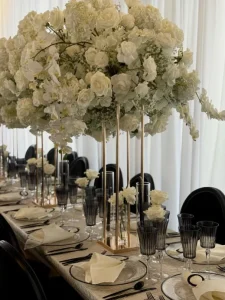
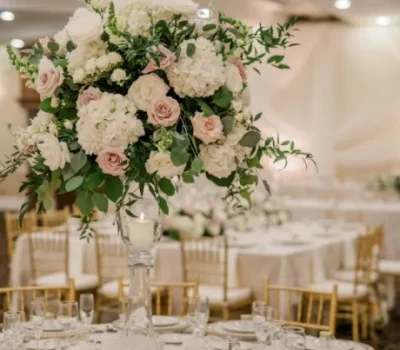
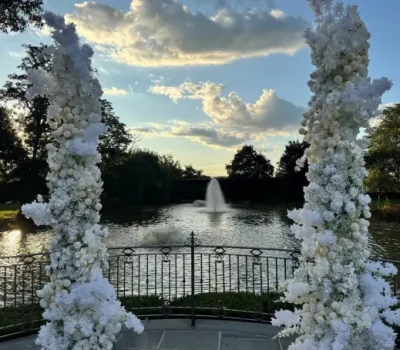
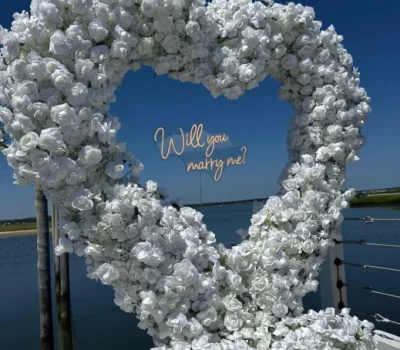
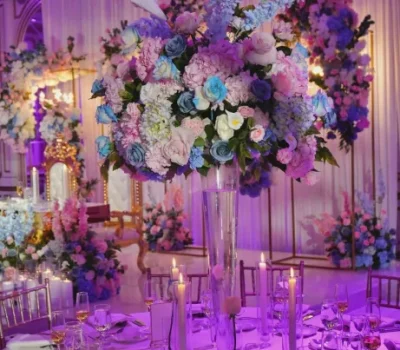
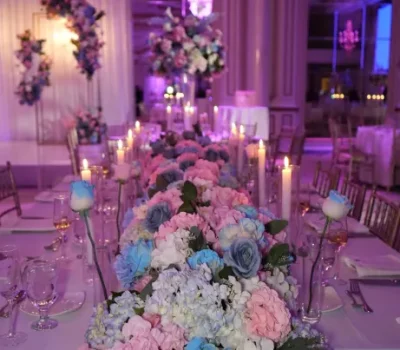
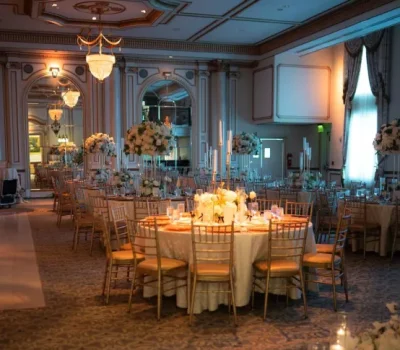
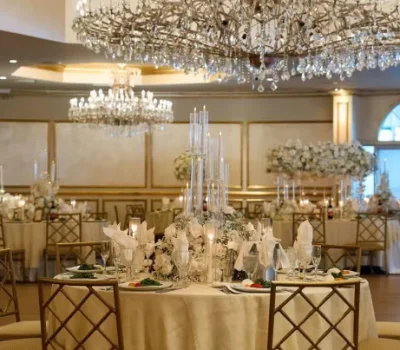
The reception is where people eat, drink, dance, cry during speeches, and spend the vast majority of the night. It’s also where your floral budget does its heaviest lifting. Bloom Wedding Florist Brooklyn has styled receptions for thirty guests in a Park Slope backyard and three hundred guests at a Williamsburg event hall – and the lesson is always the same. Reception flowers need to work harder, last longer, and cover more ground than any other floral element on your wedding day. Our team’s decade-plus of hands-on event floral design across Brooklyn means we know exactly how to make that happen without blowing your budget wide open.
Most people hear “reception flowers” and think centerpieces. That’s only part of the picture. Walk through a fully styled reception and count the floral touchpoints. Escort card table. Bar top arrangements. Cocktail hour accent pieces. Cake table florals. Lounge area accents. Restroom bud vases. Napkin blooms. Head table garland. Gift table arrangement. Dance floor perimeter. Each one of those moments is an opportunity to reinforce your color story – or, if it’s overlooked, a gap that makes the room feel unfinished.
We map the entire reception floor during planning. Not just the dining tables. Every surface a guest will see, touch, or photograph gets considered. Some of those touchpoints get full arrangements. Others get a single stem in a bud vase. A few get nothing at all because negative space matters too. The point is that someone thought about it – and that someone is your floral designer, not a day-of volunteer scrambling with leftover stems.
Cocktail hour sets the energy before the main room even opens. Guests mill around, grab drinks, nibble on passed apps, and take in the space. The florals here don’t need to be grand. They need to feel welcoming and intentional.
We typically work cocktail hour with a mix of bud vase clusters on high-top tables and one or two medium arrangements on the bar or food stations. Tight, fragrant, eye-level – the kind of thing someone leans in to smell while waiting for a drink. If we’ve repurposed ceremony pieces, this is often where they land first. An altar arrangement that took center stage twenty minutes ago now anchors the raw bar station. Guests recognize it subconsciously. It threads the two parts of the day together without anyone having to explain why.
Here’s something most wedding florists don’t talk about: guest flow. Where do people congregate? Where do they avoid? If the bar sits in a far corner, that corner needs floral presence because half your guests will spend half the night there. If the dance floor is front and center, the tables closest to it will empty out after dinner – which means you might scale down those centerpieces and put more visual weight along the perimeter where people actually linger.
We’ve watched enough Brooklyn receptions to recognize these patterns. The photo booth line always bunches near the entrance. The dessert table draws a crowd around 9:30. The lounge furniture grouping near the windows becomes the late-night hangout spot. Knowing where attention naturally lands lets us place flowers where they’ll actually get noticed instead of distributing them evenly across a room and hoping for the best.
A few well-placed stems near the bar change the whole feel of that area. Low and compact so bartenders aren’t reaching over foliage. Fragrant enough to cut through the smell of cocktails. We match bar florals to the drink menu vibe when the couple is into that level of detail – herbs like rosemary or lavender for a garden cocktail theme, deep moody blooms for a whiskey-forward bar setup.
Buffet lines and food stations can look clinical without a floral layer. Small arrangements tucked between chafing dishes or trailing greenery along the table edge soften the catering setup and tie it visually to the rest of the reception. We coordinate with your caterer on clearance heights and heat proximity so nothing wilts next to a warming tray.
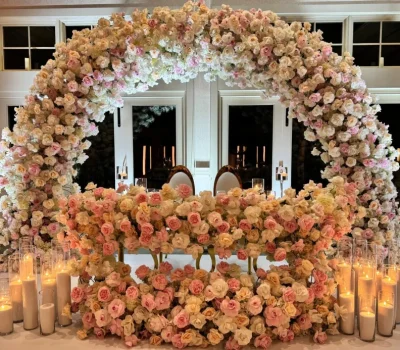
If you’re sitting at a sweetheart table, you’re essentially on display. Everyone faces you during toasts. Every speech photo includes whatever is on your table. The cake cutting probably happens within arm’s reach. This is the one table where we push the floral design further – more height, more density, more visual drama – because only two people sit there and sightlines aren’t an issue.
One couple at a MyMoon wedding in Williamsburg wanted their sweetheart table to feel like sitting inside a garden. We built flanking arrangements on pedestals at shoulder height, ran a dense garland across the front edge, and added ground-level greenery at the base. From the guest perspective, the couple appeared framed by flowers on three sides. Intimate, almost cocoon-like, and absolutely stunning in the photos. That kind of immersive treatment only works at the sweetheart table. Anywhere else it would feel claustrophobic.
The cake gets its own moment. Cutting it is a photo op. The table it sits on should reflect that importance. We usually place a loose wreath of greenery and accent blooms around the cake base, or flank it with two small arrangements that frame it without crowding the tiers. If you’re doing a dessert table instead of – or alongside – a traditional cake, the floral approach shifts. Trailing greenery along the front edge. A few bud vases tucked between cookie platters and macaron towers. Maybe a single statement arrangement at one end to anchor the display. The goal is making dessert feel like a destination within the reception, not an afterthought shoved on a folding table near the kitchen door.
First thing guests see when they walk into the reception. First. An escort card table with no floral presence feels transactional – grab your card, move along. Add a lush low arrangement and suddenly it becomes a moment. People pause. They take photos. They comment on the flowers while hunting for their name.
We’ve designed escort card displays integrated with floral installations – cards pinned into a living wall of moss and ferns at a Prospect Heights wedding. Cards clipped onto trailing vines draped across a wooden frame in Fort Greene. Cards laid flat on a bed of loose petals at a Bay Ridge waterfront reception. The format changes, but the principle holds. Give people something beautiful at the entrance and you’ve set expectations for everything that follows.
Some receptions include lounge groupings – couches, armchairs, coffee tables – for guests who want to sit outside the dining area. These zones benefit from scaled-down floral presence. A single bud vase trio on a coffee table. A small arrangement on a side console. Nothing that competes with the main tablescapes, but enough to signal that this area was designed, not forgotten.
Restrooms fall into the same category. A tiny arrangement on the vanity. It costs almost nothing relative to the overall budget and guests notice it every single time. We’ve had brides tell us months later that three different people texted them about the bathroom flowers. Sounds trivial. It’s not. Those details are what separates a wedding that felt coordinated from one that felt decorated.
Brooklyn Winery has vine-covered walls and warm wood tones. The Liberty Warehouse has soaring ceilings and industrial steel. Giando on the Water has classic elegance with waterfront views. Each space brings a built-in aesthetic that either supports your floral vision or fights against it if you ignore it.
Our approach is to lean into what the venue already provides. A room with gorgeous exposed brick doesn’t need flowers on every surface – it needs strategic floral placement that punctuates the existing character. A blank event space with white walls needs florals to carry the entire mood. Reading that difference correctly is what keeps a reception from looking like a flower shop exploded inside it. Some of the most elegant receptions we’ve designed used half the stems of the over-the-top ones because the venue was already doing so much work.
This trips up a lot of couples. You chose your palette in daylight during a venue tour. But your reception happens at night, under a mix of uplighting, candles, string lights, and DJ spots. Blush looks different under amber uplighting. White can read blue under LED washes. Deep burgundy vanishes entirely in low candlelight.
We factor this in during the design phase, not on the wedding day. If your lighting designer is using warm amber uplighting, we might push your blush palette slightly toward peach so it reads correctly at reception hour. If the room runs cool – lots of white LED, minimal candles – we warm up the bloom selection to compensate. It’s a subtle adjustment that most guests will never consciously register. But they’ll feel it. The room will feel cohesive in a way that’s hard to articulate, and that’s precisely the point.
Here’s the unglamorous reality. Most Brooklyn venues give the floral team a tight install window – sometimes as narrow as two hours between the ceremony flip and doors opening for cocktail hour. In that window, our crew unloads the van, distributes arrangements to assigned tables by number, places every accent piece, styles non-floral elements like candles and votives, does a full walkthrough for quality, and disappears before the first guest walks in.
Pulling that off requires more than strong arms. It requires a load-in plan built weeks in advance. Labeled arrangements. A printed floor map with table numbers and placement notes. Pre-staged supplies. Clear communication with the venue coordinator about elevator access, loading dock availability, and which hallway leads where. We’ve worked enough Brooklyn venues to know where the service entrances are, which ones have freight elevators that fit a six-foot arrangement, and which ones require carrying everything up two flights of stairs. None of that should ever be figured out on the wedding day itself.
When the last song plays and the lights come up, our crew returns for breakdown. Every vessel, every riser, every pin frog gets packed out. We leave the venue clean. If guests want to take centerpieces home – and they usually do – we coordinate with your planner to make that happen smoothly. Small cards at each table letting guests know the arrangement is theirs to grab. Or a designated pickup area near the exit.
Some couples also ask us to set aside specific arrangements for family members. The mother of the bride gets the sweetheart table garland. A grandmother takes home a bud vase trio. We tag those pieces before the reception even starts so nothing gets lost in the shuffle. It’s a five-minute task during install that saves a lot of emotional energy later.
Ceremony florals get fifteen minutes. Cocktail hour gets forty-five. But reception flowers sit in front of your guests for four, five, sometimes six hours straight. People stare at them during dinner. Lean into them for photos. Touch them. Smell them. Move them aside to make room for dessert plates and then put them back. Your reception florals need to hold up physically and visually across an entire evening of food, drinks, movement, and fluctuating temperatures.
That endurance factor shapes how we build. We choose hearty varieties for reception work. We condition longer. We hydrate obsessively. And we design with density so that even if one bloom softens by hour five, the arrangement still reads full and intentional. That’s the kind of foresight you get from a Brooklyn wedding florist who treats reception design as the main event – because for your guests, it is.
Get in touch with Bloom Wedding Florist Brooklyn at (929) 673-2834 or come by 111 Herkimer St, Brooklyn, NY 11216. Your reception flowers deserve the same creative energy as every other part of your day – probably more.