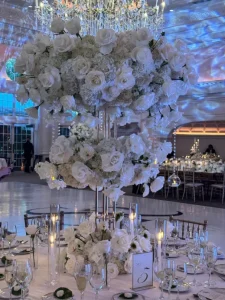
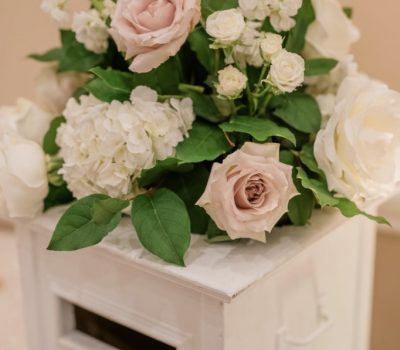
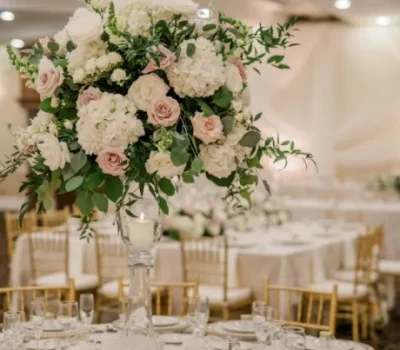
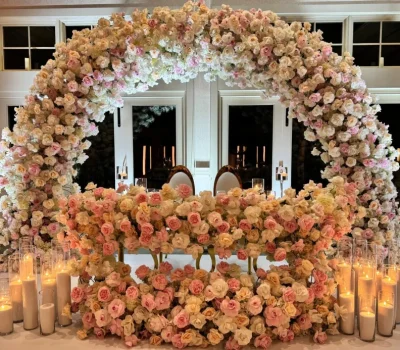
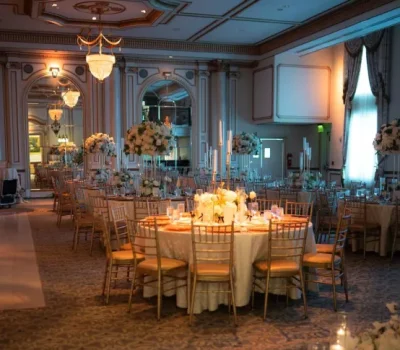
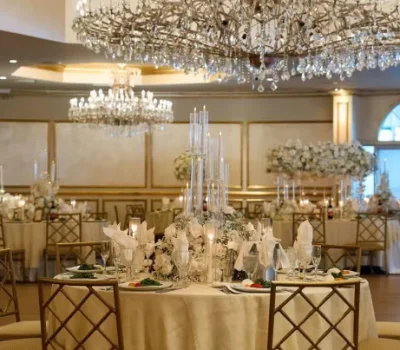
The ceremony is fifteen minutes, maybe twenty. But those minutes carry more emotional gravity than any other part of the wedding – and every guest is facing one direction the entire time. Whatever sits behind you, beside you, or above you during your vows becomes the visual frame for the most photographed moments of the day. Bloom Wedding Florist Brooklyn designs ceremony florals with that weight in mind, drawing on years of firsthand installation work at indoor chapels, outdoor gardens, rooftops, and converted warehouses across the borough.
Here’s what makes ceremony florals different from everything else we design. At the reception, flowers compete with food, music, movement, conversation. Guests notice them peripherally. During the ceremony? Nothing else exists. People are seated, facing you, with their phones out and their attention locked. The flowers framing your vows are essentially a stage set – and they’ll appear in hundreds of photos from dozens of angles, many of which you won’t control.
That changes how we approach the design entirely. We don’t just think about what looks beautiful from the front. We think about what the photographer captures from the balcony. How the arrangement reads in a wide shot from the back row. Whether the colors separate cleanly from the wall behind them or blend into a muddy wash. These aren’t afterthoughts. They’re the foundation of our ceremony design process, and they’re the reason couples across Brooklyn hire a dedicated floral designer rather than asking their venue to handle it.
An altar arrangement needs to do two things simultaneously: fill space and not overwhelm the people standing in front of it. That sounds contradictory, and honestly, it kind of is. Too large and it dwarfs the couple. Too small and the ceremony photos look bare, like someone forgot to finish decorating.
Finding that sweet spot is one of those skills that only develops through repetition. We’ve built altar arrangements on raised platforms at 501 Union where an extra eight inches of height made all the difference. We’ve scaled them way down for City Hall elopements where the architecture itself was ornate enough to carry the room. At a recent Prospect Park Boathouse ceremony, we used two asymmetrical ground arrangements flanking the couple instead of a single centered piece – broke the expected symmetry and gave the photographer more compositional options. These kinds of choices matter far more than which specific flowers go into the vase.
Some couples want a clean aisle. A few petals scattered, maybe a small arrangement on every third chair, nothing that competes with the walk itself. Other couples want the aisle to feel like a garden path – lush ground arrangements on both sides, hanging elements from shepherd’s hooks, loose greenery spilling into the walkway just enough to brush a hemline without tripping anyone.
Both approaches work. The deciding factors are usually venue width, dress silhouette, and photography style. A narrow aisle in a Greenpoint loft needs restraint – crowding it with floor arrangements creates a bottleneck that looks cluttered on camera. A wide-open ceremony lawn in Red Hook gives you room to build dramatic aisle borders that establish the floral story before guests even look up at the altar. We measure, we sketch, and we mockup spacing before committing to a direction. The aisle is a runway. It deserves that level of planning.
Not every ceremony has an aisle lined with arrangements, and that’s fine. Sometimes a single bloom tied with ribbon to every other chair creates a cleaner visual rhythm than a dozen ground pieces fighting for attention. We stock ribbon in over forty colors and textures so the tie detail coordinates seamlessly with the rest of your palette.
Budget-conscious couples love this move. We design certain ceremony pieces – altar arrangements, aisle markers – so they can be physically relocated to the reception space during cocktail hour. Your cocktail tables, bar tops, or restroom vanities get instant floral presence using arrangements your guests already admired thirty minutes earlier. Less waste, more value, same quality.
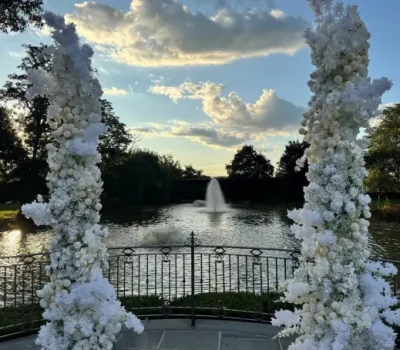
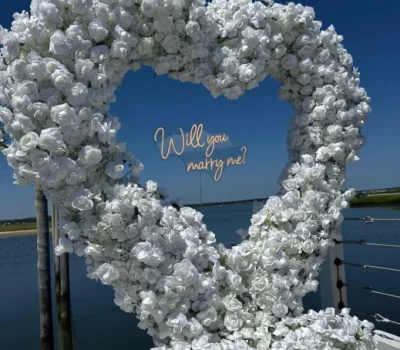
This is where ceremony floral design becomes part engineering, part sculpture. A freestanding arch or chuppah is a three-dimensional structure that needs to hold weight, resist wind if it’s outdoors, look finished from every angle, and – above all – not collapse during vows. We’ve been building these across Brooklyn long enough to know exactly where the risks live.
Wooden arches get foliage wired directly to the frame. Metal structures receive zip-tied greenery bases before blooms get tucked in at varying depths. Chuppahs draped in fabric require a different attachment system than bare-frame versions because you’re dealing with tension and movement from the textile layer. None of this is visible to guests. All of it is critical to the finished piece lasting five uninterrupted hours in whatever conditions your venue throws at it.
One chuppah we built for an autumn wedding in Brooklyn Heights used dried pampas grass mixed with fresh garden roses, trailing amaranthus, and copper beech branches. The textures caught afternoon light in a way that made the structure feel alive. Another – a minimalist birchwood arch for a DUMBO rooftop ceremony – carried just three loose clusters of white phalaenopsis orchids and a single draping vine. Completely different aesthetic, same structural discipline underneath.
Brooklyn has no shortage of stunning outdoor ceremony locations. Prospect Park, Brooklyn Bridge Park, rooftops with skyline views in Williamsburg – all gorgeous, all unpredictable. We’ve watched a gust off the East River rattle a flower wall hard enough to shift an entire installation sideways. That experience is exactly why we overbuild everything intended for outdoor use.
Heavier vessels with sand-weighted bases. Wire reinforcement inside arrangements that would normally stand on their own indoors. Bloom choices that tolerate direct sun without browning in an hour – think garden roses over peonies in July, orchids over sweet peas in August. Hydration tubes tucked invisibly into arch builds so stems keep drinking even when they’re suspended six feet off the ground. These are the precautions a seasoned wedding florist takes without being asked. Because the alternative – wilting, tipping, collapsing – isn’t something you fix once the ceremony starts.
On the other end of the spectrum, indoor venues bring their own set of design questions. Does the room already have strong visual character – stained glass, exposed brick, ornate molding – that your florals should complement rather than compete with? Or is it a blank canvas warehouse space where the flowers carry the entire aesthetic responsibility?
We’ve designed ceremony installations inside landmarked Brooklyn brownstones where we barely touched the mantelpiece because the carved marble spoke for itself. A single urn arrangement with seasonal branches and a few statement blooms was all the room needed. Meanwhile, a whitewashed Bushwick studio space got the opposite treatment – a massive asymmetrical arch crawling with smilax vine, roses, and hanging orchids because the walls gave us nothing to work with. Reading the room is literal in ceremony floral design. We walk your venue, study what’s already there, and design to fill the gaps – not paste over what makes the space interesting in the first place.
Not every wedding ceremony follows the traditional aisle-and-altar format, and our designs don’t either. Theater-in-the-round seating where guests surround the couple? We’ve done floral ground circles that define the ceremony space without blocking sightlines from any direction. Spiral seating? Arrangements placed at key turning points along the walkway to guide movement naturally. Ceremonies on staircases, in courtyards, on piers – each layout asks for something different, and our design brain starts working the minute we see a floor plan.
One couple at a Fort Greene brownstone exchanged vows on the front stoop with guests watching from the sidewalk below. The entire ceremony floral design was a cascading arrangement spilling over the brownstone railing – visible from street level, dramatic in photos, and built to withstand foot traffic on both sides. Unconventional spaces are some of our favorite challenges. They force creative solutions that a ballroom ceremony never would.
Most ceremony florals get about ninety minutes of spotlight. Processional, vows, recessional, family formals, couple portraits in front of the altar. Then guests move to cocktail hour and the ceremony space empties. What happens to all that work?
If repurposing is part of your plan, our crew handles the move during the transition window. Altar arrangements relocate to the reception entrance or the bar. Chair flowers get redistributed to cocktail tables. Arch greenery stays put if the ceremony and reception share a room, giving the space visual continuity through the night. If repurposing isn’t feasible – outdoor ceremony with an indoor reception at a different location, for example – we design the ceremony budget accordingly so you’re not overspending on pieces with a short lifespan. Honest budgeting beats beautiful waste every time.
Here’s a detail most couples don’t think about until the week of: where exactly does the officiant stand? Does the venue allow open flames? Are there noise restrictions that affect install timing? Can we nail into the wall or does everything need to be freestanding? Is there a venue coordinator who needs a load-in schedule seventy-two hours in advance?
We handle all of this communication directly. Before your ceremony week, we’ve already confirmed access times with the venue, coordinated placement with your officiant, aligned with your photographer on which angles they plan to shoot, and communicated flip logistics with your planner if the ceremony and reception share a room. The ceremony unfolds smoothly partly because beautiful flowers frame it – but mostly because a team of people worked out the details weeks earlier. That behind-the-scenes coordination is a core part of what Bloom Wedding Florist Brooklyn delivers.
Guests walk into the ceremony and the flowers tell them what kind of wedding this is going to be. Romantic. Modern. Wild. Intimate. Grand. Whatever that opening note is, we make sure it rings clearly. And when the ceremony ends and the celebration begins, the memory of that first visual impression stays with people. It sets expectations for the rest of the night – expectations that a thoughtfully designed reception then fulfills.
Your ceremony deserves a floral designer who treats it as its own creative project, not an add-on to the reception quote. Call Bloom Wedding Florist Brooklyn at (929) 673-2834 or come see us at 111 Herkimer St, Brooklyn, NY 11216. That first conversation about your ceremony space is where everything starts to feel real.